
Multimodal Bill of Lading

multimodal bill of lading

Multimodal transportation is the movement of one unit load from origin to destination by several methods or transportation under one document without breaking up the unit load.

A very good example of a multimodal transportation is that containers loaded in continental Europe travel by train to Rotterdam, then ship on a vessel to Dar Es Salaam, then are delivered inland in Tanzania by truck. (Source: UNDP Shipping and Incoterms Practice Guide, Page: 6)

Multimodal bill of lading is a transport document that is evidencing more than one mode of transport, one of which is typically by sea shipment, although it is not required.

Bill of lading for combined transport is another name of the multimodal bill of lading.

MMBL (Multimodal Bill of Lading) or MMTD (Multimodal Transport Document) are the most frequently used abbreviations.

Types of Multimodal Transport Documents:

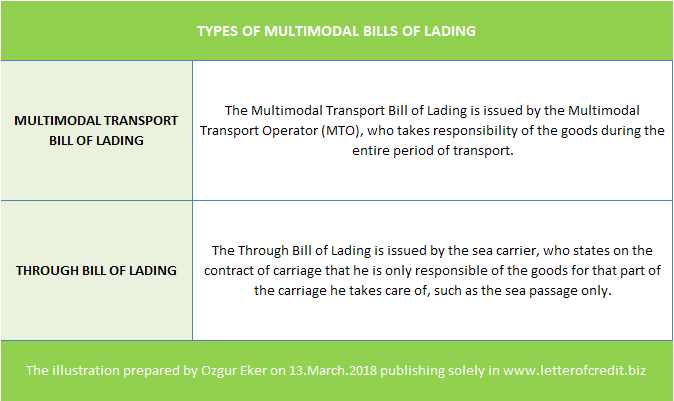
Multimodal bills of lading can be classified under two main types: multimodal transport bill of lading and through bill of lading.
types of multimodal bill of lading

Multimodal Transport Bills of Lading: These types of multimodal bills of lading are issued by a multimodal transport operator and mostly printed on FIATA (International Federation of Freight Forwarders Associations) standard pre-printed form.

Multimodal transport operator (MTO) means any person who concludes a multimodal transport contract and assumes responsibility for the performance thereof as a carrier for the whole journey.

Through Bills of Lading: Through Bills of Lading are virtually identical to the Multimodal Transport Bills of lading but with one major difference.

The Multimodal Transport Bill of Lading is issued by the Multimodal Transport Operator (MTO) (shipping lines, freight forwarders, NVOCC Operators) who takes responsibility of the goods (e.g. shortages, losses, damages) during the entire period of transport, thus not only for the sea passage but also for the other transport modes as well.

The Through Bill of Lading is issued by the sea carrier but the carrier states on the contract of carriage that he is only responsible of the goods for that part of the carriage he takes care of, such as the sea passage only. (Source : www.maritimeknowhow.com )

How to Use Multimodal Bill of Lading in Letters of Credit Transactions:

The rules related to the multimodal bill of lading can be found under article 19 of UCP 600.

A transport document covering at least two different modes of transport (multimodal or combined transport document), however named, must appear to:

  1. indicate the name of the carrier and be signed by:
    • the carrier or a named agent for or on behalf of the carrier, or
    • the master or a named agent for or on behalf of the master.
  2. indicate that the goods have been dispatched, taken in charge or shipped on board at the place stated in the credit.
  3. indicate the place of dispatch, taking in charge or shipment and the place of final destination stated in the credit,
  4. be the sole original transport document or, if issued in more than one original, be the full set as indicated on the transport document.
  5. contain terms and conditions of carriage or make reference to another source containing the terms and conditions of carriage (short form or blank back transport document).
  6. contain no indication that it is subject to a charter party. (Source : UCP 600)

Special Hints Regarding the Multimodal Bill of Lading From ISBP (International Standard Banking Practice):

  • In all places where the term “multimodal transport document” is used within this document, it also includes the term combined transport document.
  • A document need not be titled “Multimodal transport document” or “Combined transport document” to be acceptable under UCP 600 article 19, even if such expressions are used in the credit.
  • If a credit requires presentation of a transport document covering transportation utilizing at least two modes of transport … the transport document must not indicate that shipment or dispatch has been effected by only one mode of transport.

Multimodal Bill of Lading Example:

You can find a multimodal bill of lading example below, that is evidencing a soybean shipment from USA to Japan.
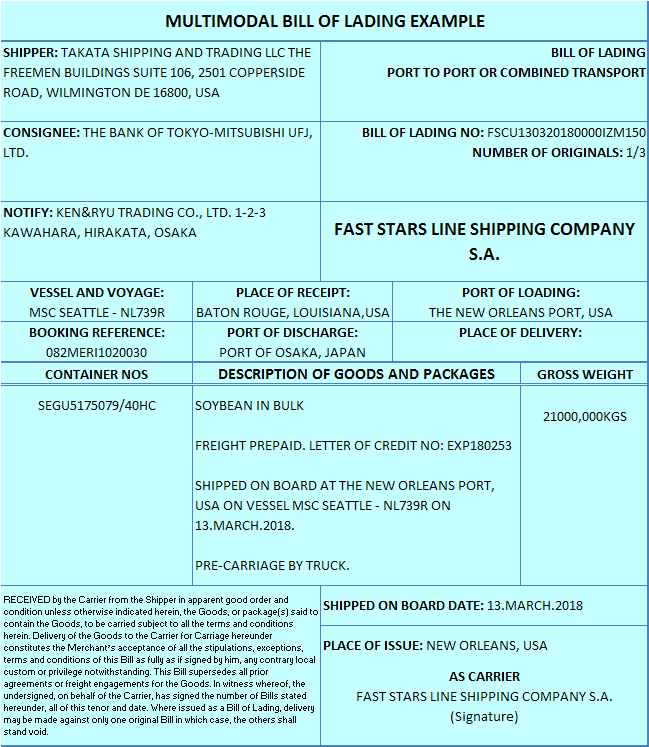
multimodal bill of lading example

Above multimodal bill of lading evidencing both road and sea transportation. It is most probably issued by a freight forwarder, because of the fact that the transport document has been signed “As CARRIER”.

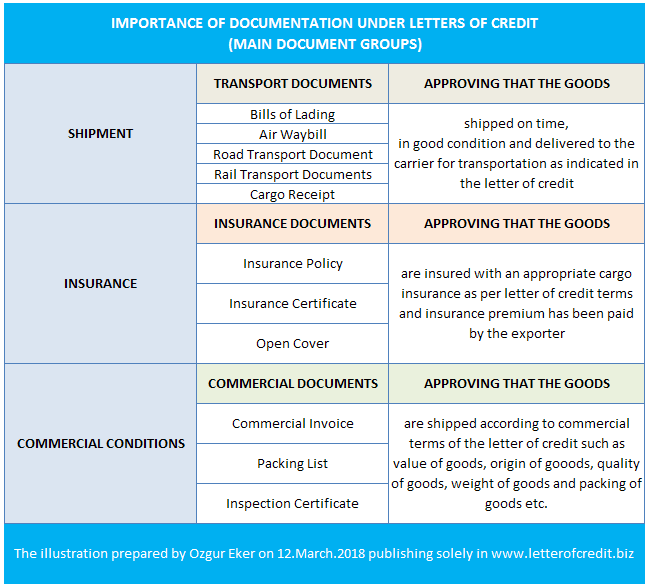
Letter of Credit Documents

letter of credit documents

After reading this post, you should understand why documentation is very important under letters of credit.

Additionally, most frequently used document links have been supplied on later parts of this article.

There are many important points in a typical letter of credit transaction that need to be taken care of professionally.

However, documentation is much more important than any other aspects of the letters of credit transactions, because the documentation forms the backbone of the letters of credit structure.

In order to understand the importance of the documentation, please assume that you are an exporter, whom has just shipped an order.

How can you prove to the issuing bank that you have make the shipment according to the letter of credit terms?

Which means that;

  • you have shipped the goods on time, not late
  • you have shipped the right goods, not wrong ones
  • you have shipped the goods in good condition, no apparent defect on the packing
  • you have delivered the goods to the carrier for transportation from port of loading to the port of discharge indicated in the credit etc.

In order to prove above points to the issuing bank, you have to supply a relevant transport document.

Furthermore, let us also consider that the delivery term was CIF Incoterms 2010, which obligates the exporter, which is you, to arrange and pay the insurance for the shipment.

Once again, you have to supply an insurance policy to fulfill your insurance responsibility.

The examples can be extended, but perhaps the main idea is very clear. Letters of credit transactions are related to the documents only, not actions.

importance of letter of credit documentation

The importance of the documentation is stated in UCP 600 article 5 as follows:

Banks deal with documents and not with goods, services or performance to which the documents may relate.

In addition, every condition stated in the letter of credit must be connected to a document. This point is also clearly indicated in UCP 600 article 14 as below.

If a credit contains a condition without stipulating the document to indicate compliance with the condition, banks will deem such condition as not stated and will disregard it.

Documents Most Frequently Used Under Letters of Credit Transactions:

Transport Documents:

Insurance Documents:

Financial Documents:

Commercial Documents:

Official Documents:

Inspection Certificate Discrepancies

inspection certificate discrepancies

On this page you can find most common discrepancies related to the inspection certificate, which is issued under a typical letter of credit transaction.

Discrepancy can be defined as an error or defect, according to the issuing bank, in the presented documents compared with the documentary credit, the UCP 600 rules or other documents that have been presented under the same letter of credit.

Inspection in international trade can be defined as a process of checking the quality of goods against the contractual requirements.

Inspection certificate is the document that is usually issued by the inspection company after completion of the inspection.

Inspection certificate provides data on the result of the inspection.

Inspection Certificate Discrepancies

  • Inspection Certificate Not Issued and Signed by the Party Required by the Letter of Credit
  • Total Quantity Indicated on the Certificate of Inspection is not in Accordance with the Bill of Lading and Certificate of Origin
  • Inspection Certificate Is not Dated within the Timeline Required by the Documentary Credit
  • Inspection Certificate Identifies Different Goods Inspected Inconsistent with Those Described by Commercial Invoices
  • Inspection Certificate Indicates That Goods Do not Comply with the specifications
  • Inspection Certificate Indicates That Packing is not as per L/C.
  • Pre-shipment Inspection Certificate Shows Date of Inspection a Later Date Than Date of Shipment

Important Points Regarding the Inspection Certificates under Letter of Credit Rules:

  • When a credit requires the presentation of an inspection certificate, this will be satisfied by the presentation of a signed document titled as inspection certificate, or bearing a similar title or even untitled, which fulfills its function by certifying the result of the indicated action, for example, the results of the inspection.
  • When a credit requires the presentation of a pre-shipment inspection certificate, which relates to an action required to take place on or prior to the date of shipment, the certificate must indicate:

a. an issuance date of the certificate is no later than the date of shipment; or
b. stating that the inspection of goods took place prior to, or on the date of shipment,
c. the exact title of the required certificate, such as, “Pre‐shipment Inspection Certificate”.

  • An inspection certificate should be issued by the institution stated in the credit.
  • When a letter of credit does not state the title of an issuer, any institution including the beneficiary could issue the inspection certificate.
  • When a letter of credit indicates specific requirements with respect to inspection, the data regarding the inspection mentioned on the inspection certificate should comply with those requirements.

Inspection Certificate Not issued and Signed by the Party Required by the Letter of Credit Discrepancy

inspection certificate not issued as per letter of credit

Inspection in international trade can be defined as a process of checking the quality of goods against the contractual requirements.

Because, the importer and exporter are located in different countries, and they are usually living very away from each other, as a result it would not be feasible for the importer to send someone to check the quality of goods for each shipment.

If the importer (the applicant) is not able to send a person he trusts to the place of shipment, he can ask an internationally recognized inspection company, such as the Geneva-based Société Générale Surveillance (SGS) to perform the inspection required.

The applicant will instruct the inspection company as to the manner in which it is to check the goods and what they must look for. (1)

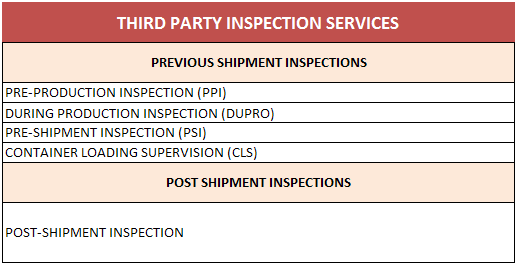
Third party inspection services in international trade can be grouped under two main categories.

  1. Previous Shipment Inspections, which are performed before the goods are shipped from the exporter’s factory and
  2. Post Shipment Inspections, which are performed after the goods are shipped from the exporter’s factory.

types of inspection

Inspections, which are performed before the goods are shipped from the exporter’s factory are as follows:

  1. Pre-Production Inspection (PPI)
  2. During Production Inspection (DUPRO)
  3. Pre-Shipment Inspection (PSI)
  4. Container Loading Supervision (CLS) or Container Loading Inspection (CLI)

Inspections, which are performed after the goods are shipped from the exporter’s factory are as follows:

  1. Post-Shipment Inspection (2)

Inspection certificate is the document that is issued by the inspection company after completion of the inspection. Inspection certificate provides data on the result of the inspection.

The inspection certificate should be issued by the party stated in the letter of credit.

According to the letter of credit rules and standard banking practices an inspection certificate, however named, must appear to be issued and signed by the entity stated in the letter of credit.

For example, if the letter of credit requires that pre-shipment inspection certificate should be issued by SGS, Intertek or CCIC Inspection Company, the inspection certificate that has been presented by the beneficiary must be issued and signed by one of these independent inspection companies.

If issuing bank finds out that an inspection certificate has not been issued and signed by the entity as required by the letter of credit, then the issuing bank will raise a discrepancy, which is known as inspection certificate not issued and signed by the party required by the letter of credit.

Letter of Credit Discrepancy Example: Inspection Certificate Not Issued and Signed by the Party Required by the Letter of Credit

A letter of credit has been issued in SWIFT format, subject to UCP latest version, with the following details:

Letter of Credit Conditions

Field 45A: Description of Goods and or Services: 20 mtons of %100 organic Italian Extra Virgin olive Oil. Delivery Terms: CIF Port of Newark, USA Incoterms 2010.

Field 46A: Documents Required:

  1. Beneficiary’s dated and manually signed commercial invoice in duplicates bearing full description of goods and its quantity, net and gross weight, unit and total price.
  2. Insurance policy covering all risks showing claims payable in USA.
  3. 3/3 full set original clean bills of lading made out to order of issuing bank, notify applicant company indicating freight prepaid stating the name, telephone and fax numbers of carrier’s agent in port of discharge. Bill of lading should evidence shipments made in refrigerated 40′ closed containers.
  4. The original inspection certificate issued not prior to marine bill of lading date by S.G.S or its authorized agent on S.G.S letter head certifying that the goods shipped/inspected are in conformity with the quality, quantity, and packing of the goods loaded are strictly complying with specifications of the goods indicated in the relative Purchasing Instruction, the terms of the l/c and all subsequent amendments as presented to S.G.S by the importer. The inspection certificate shall verify that the goods are in conformity with USDA organic food standards.

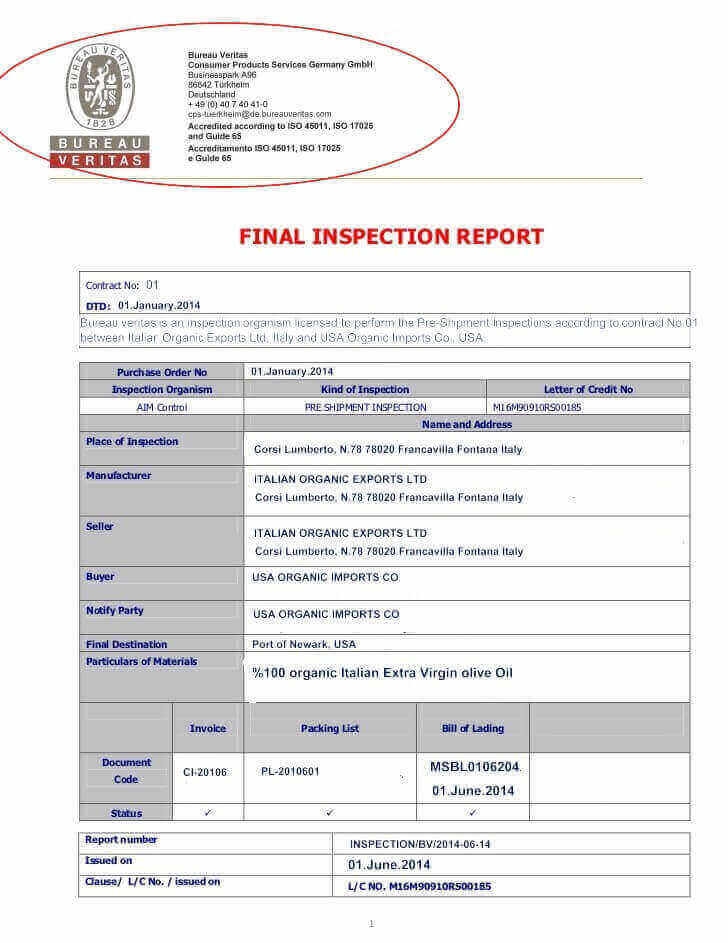
The beneficiary presented an insurance policy as shown on the below picture.

Inspection Certificate

Discrepancy Example: Inspection Certificate Not issued and Signed by the Party Required by the Letter of CreditDiscrepancy: Inspection certificate should have been issued by S.G.S or its authorized agent on behalf of S.G.S inspection company. On the other hand, the inspection certificate has been issued by another inspection company.

Reason for Discrepancy: According to letter of credit rules and standard banking practices an inspection certificate, however named, must appear to be issued and signed by the entity stated in the letter of credit.

References:

  1. Documentary Credits in Practice, Second edition 2009, Nordea, Page:174, Reached: 07.March.2018
  2. What is a Pre-Production Inspection (PPI)?, www.advancedontrade.com, Reached: 07.March.2018

Multimodal Bill of Lading Discrepancies

multimodal bill of lading discrepancies

Multimodal transportation is the movement of one unit load from origin to destination by several methods or transportation under one document without breaking up the unit load.

The development of container traffic has made this possible, as containers can travel from end to end without being opened/unloaded/reloaded during the course of the journey.

The advantage for those who make use of multimodal transportation is that they have one document only for the whole operation and that the operator is legally responsible for a satisfactory overall performance by his own staff and by the agents or branches that he is employing.(1)

Multimodal bill of lading is the transport document that covers at least two different modes of transport.

On this page you can find most common discrepancies related to the multimodal bills of lading under the letters of credit transaction.

Multimodal Bill of Lading Discrepancies

Important Definitions Regarding the Multimodal Bill of Lading under Latest Letter of Credit Rules:

  • According to latest UCP 600 letter of credit rules a multimodal bill of lading should not bear any indication that it is subject to charter party.
  • All original multimodal bills of lading printed by the carrier must be presented to the bank by the beneficiaries.
  • It is hard to prevent a transshipment in a multimodal transportation as a result even letter of credit prohibits transshipment multimodal bill of lading can state ‘Transshipment may/will take place.”
  • Multimodal bill of lading should be regarded as a negotiable transport document like a bill of lading if the last mode of shipment in the entire journey is completed by sea transportation.
  • More than one notify parties could be stated in a multimodal bill of lading.
  • ‘To Order’ or ‘To the order of shipper’ means that multimodal bill of lading should be endorsed by the shipper as per letter of credit instructions.

References:

  1. Shipping and Incoterms, Practice Guide, UNDP Practice Series, Page: 6

Multimodal Bill of Lading Does Not Cover At Least Two Different Modes of Transport Discrepancy

Multimodal Bill of Lading Does Not Cover At Least Two Different Modes of Transport Discrepancy

A transport document covering at least two different modes of transport is regarded as a multimodal bill of lading according to the letter of credit rules.

If the letter of credit asks for a multimodal bill of lading or a combined bill of lading, however named, the transport document which will be presented by the beneficiary must be covering at least two different modes of transport.

It is worth mentioning that the title of the transport document is irrelevant according to the letter of credit rules.

The transport document presented needs not to be titled “Multimodal bill of lading” or “Combined bill of lading” or words of similar effect even when the credit so names the required document.

The important point is the content of the transport document not the title.

Single Modes of Transport Examples:

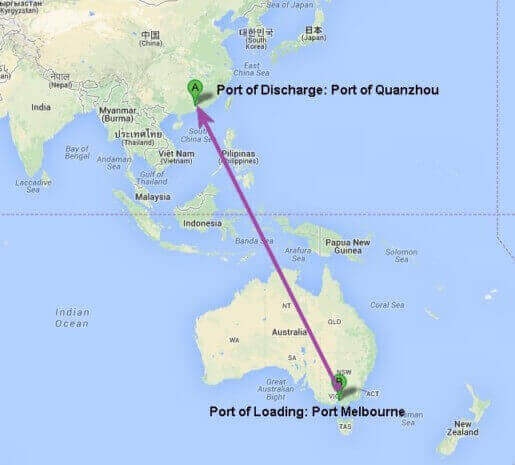
Sample 1 : Shipment Effected From Melbourne Port, Australia to Port of Guangzhou, China

single mode of transport example 1

  • Transport Document Title: Multimodal Bill of Lading
  • Port of Loading: Port Melbourne, Australia
  • Port of Discharge: Port of Guangzhou, China

Only sea shipment has been effected.

This is a port to port marine bill of lading not a multimodal bill of lading.


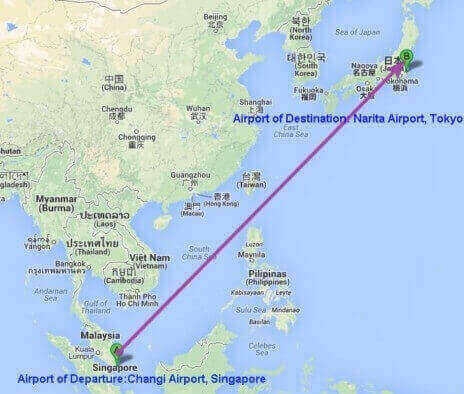
Sample 2 : Shipment Effected From Changi Airport, Singapore to Narita Airport, Tokyo

Changi Airport, Singapore to Narita Airport, Tokyo

  • Transport Document Title : Combined Bill of Lading
  • Airport of Departure: Changi Airport, Singapore
  • Airport of Destination: Narita Airport, Tokyo

Only air shipment has been effected.

This transport document can be treated as an air waybill not a combined bill of lading.


Multimodal Transport Examples:

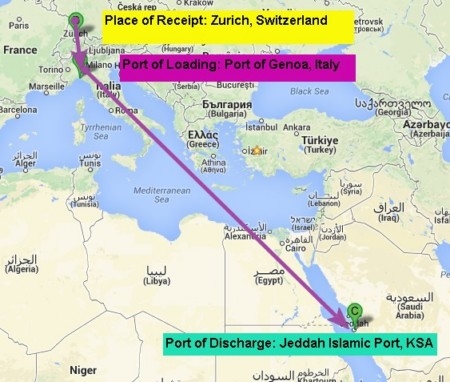
Sample 1 : Multimodal Shipment Effected via Land and Sea Shipments 

Multimodal Shipment Effected via Land and Sea Shipments Transport Document Title: Multimodal Bill of Lading
Place of Receipt: Zurich, Switzerland
Port of Loading: Port of Genoa, Italy
Port of Discharge: Jeddah Islamic Port, KSA

Land and sea shipment has been effected together.

This is a multimodal bill of lading.

If the issuing bank finds out that single mode of transport effected on the multimodal bill of lading, then the issuing bank will issue a discrepancy, which is known as multimodal bill of lading does not cover at least two different modes of transport.

Letter of Credit Discrepancy Example: Multimodal Bill of Lading Does Not Cover At Least Two Different Modes of Transport

A letter of credit has been issued in SWIFT format, subject to UCP latest version, with the following details:

Letter of Credit Conditions

Field 44A: Place of Taking in Charge/Dispatch from …/Place of Receipt: Durban, South Africa

Field 44B: Place of Final Destination/For Transportation to …/Place of Delivery: Utrecht, Holland

Field 46A: Documents Required: Full set of multimodal transport document marked freight collect made out to order of Amsterdam Trade Bank marked notify applicant indicating that the goods have been dispatched, taken in charge or loaded on board.

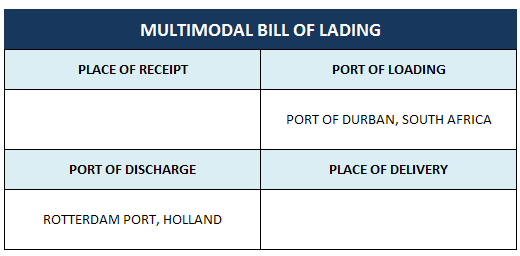
The beneficiary presented a combined bill of lading with the following data:

Multimodal Bill of Lading

Port of Loading: Port Of Durban, South Africa

Port of Discharge: Rotterdam Port, Holland

Discrepancy: Multimodal bill of lading does not show at least two different modes of transport. Only sea transportation has been effected.

Reason for Discrepancy: A multimodal transport document must be covering at least two different modes of transport.

The essence of multimodal transport document is that it is evidencing at least two different modes of transport.

As an example, the multimodal bill of lading can show dispatch from an inland point, such as a road transportation from an inland point to the port of loading located in the country of export, and then consequent shipment by sea from port of loading to the port of discharge.

or any other combinations of different delivery places, so that at least two different modes of transport is utilized.

Unclean Multimodal Bill of Lading Presented Discrepancy

Unclean Multimodal Bill of Lading Presented Discrepancy

Banks accept only clean transport documents.

Banks do not accept any unclean transport document such as unclean bill of lading, unclean multimodal bill of lading, unclean charter party bil of lading, unclean road transport document, unclean air transport document, unclean sea waybill etc.

Letter of credit rules define clean transport document as follows: “A clean transport document is one bearing no clause or notation expressly declaring a defective condition of the goods or their packaging.”

There are two important points about the clean transport documents subject that everyone must know.

The first important point is that the word “clean” need not appear on a transport document, even if a credit has a requirement for that transport document to be “clean on board”.

The second important point is that only express clauses or notations on the transport documents would make them unclean.

If transport document is not to include a clause that expressly declare a defective condition of the goods or their packaging, then it is accepted as a clean transport document.

Sample Clauses That Make a Transport Document Unclean:

• Packaging is not sufficient for the sea journey
• Goods which improperly stored at the port of loading have been shipped on board partially wet and not in good condition.

Let us try to understand the subject with an example as below:

Letter of Credit Discrepancy Example: Unclean Multimodal Transport Document Presented Discrepancy

A letter of credit has been issued in SWIFT format, subject to UCP latest version, with the following details:

Letter of Credit Conditions

Field 45A: Description of Goods and or Services: Furniture and Equipment

Field 46A: Documents Required: Full set of clean on board multimodal transport document marked freight collect made out to order of Commercial Bank of Ethiopia marked notify applicant indicating that the goods have been dispatched, taken in charge or loaded on board.

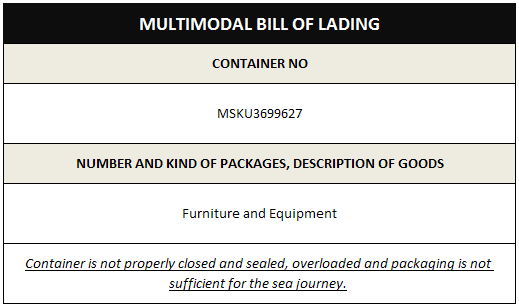
The beneficiary presented a multimodal transport bill of lading with the following clause:

Container is not properly closed and sealed, overloaded and packaging is not sufficient for the sea journey.

Multimodal Bill of Lading

Unclean multimodal bill of lading

Discrepancy: Unclean multimodal bill of lading presented.

Reason for Discrepancy: A bank will only accept a clean transport document. A clean transport document is one bearing no clause or notation expressly declaring a defective condition of the goods or their packaging.

Place of Receipt Different than the Letter of Credit Discrepancy

Place of Receipt on a Multimodal Bill of Lading Different than the Letter of Credit Discrepancy

Multimodal bill of lading is a type of transport document, that is used when the shipment covers at least two different modes of transport.

On a typical multimodal bill of lading, there are 4 different places exist in regards to delivery of goods:

  1. Place of Receipt: is the place where the goods are received from the shipper by the carrier, or its agent
  2. Port of Loading: is the place where the goods are received for marine transport by the Carrier
  3. Port of Discharge: is the place where the goods are to be discharged from the vessel
  4. Place of Delivery: is the place where the goods are delivered by the carrier to the buyer

According to the letter of credit rules, the multimodal bill of lading must indicate that goods have been taken in charge at the place stated in the letter of credit, by either a pre-printed wording or by a notation indicating the date on which the goods have been taken in charge.

If the issuing bank finds out that the place of receipt on the multimodal bill of lading is inconsistent with the letter of credit terms, then the issuing bank will issue a discrepancy, which is known as place of receipt different than the letter of credit.

Letter of Credit Discrepancy Example: Place of Receipt Different Than the Letter of Credit on the Multimodal Bill of Lading 

A letter of credit has been issued in SWIFT format, subject to UCP latest version, with the following details:

Letter of Credit Conditions

Field 44A: Place of Taking in Charge/Dispatch from …/Place of Receipt: SAO PAULO, BRAZIL

Field 44E: Port of Loading/Airport of Departure: SANTOS PORT, BRAZIL.

Field 44F: Port of Discharge/Airport of Destination: PORT OF FELIXSTOWE, UNITED KINGDOM

Field 44B: Place of Final Destination/For Transportation to …/Place of Delivery: IP1 3EE PINEWOOD, IPSWICH, UNITED KINGDOM

Field 46A: Documents Required: Full set of combined transport document issued by a shipping company marked freight collect made out to order of HSBC BANK marked notify applicant indicating that the goods have been dispatched, taken in charge or loaded on board.

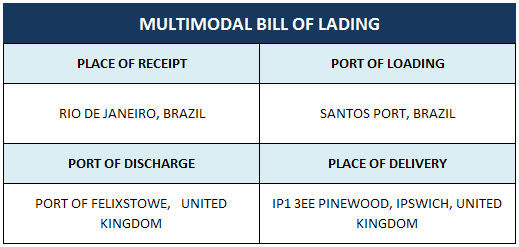
The beneficiary presented a combined bill of lading with the following data:

Multimodal Bill of Lading

Field 44A: Place of Taking in Charge/Dispatch from …/Place of Receipt: RIO DE JANEIRO, BRAZIL

Port of Loading: SANTOS PORT, BRAZIL

Port of Discharge: PORT OF FELIXSTOWE, UNITED KINGDOM

Place of Final Destination: IP1 3EE PINEWOOD, IPSWICH, UNITED KINGDOM

multimodal bill of lading place of receipt discrepancy

Discrepancy: Multimodal bill of lading shows a place of receipt different than the letter of credit.

Reason for Discrepancy: A multimodal bill of lading must indicate that goods have been dispatched or taken in charge at the place stated in the letter of credit.

Description of Goods on the Multimodal Bill of Lading is Inconsistent Discrepancy

Description of Goods on the Multimodal Bill of Lading is Inconsistent Discrepancy in Letters of Credit

According to the letter of credit rules, the commercial invoice must contain a description of goods, which corresponds to that indicated in the credit.

Other documents may or may not contain a description of goods.

If a document other than the commercial invoice, such as a bill of lading, packing list, certificate of origin, multimodal bill of lading etc., bears a description of goods, this should be in general terms but not inconsistent with that shown in the credit.

What everyone needs to know about the description of goods on a multimodal bill of lading is that the description of goods on a multimodal bill of lading can be indicated in general terms as long as it is not inconsistent with other documents and the letter of credit itself.

If the issuing bank finds out that the description of goods on the multimodal bill of lading is inconsistent with the letter of credit terms, then the issuing bank will issue a discrepancy, which is known as inconsistent description of goods.

Letter of Credit Discrepancy Example: Description of Goods is Inconsistent on the Multimodal Bill of Lading

A letter of credit has been issued in SWIFT format, subject to UCP Latest Version, with the following details:

Letter of Credit Conditions

Field 45-A: Description of Goods: Cocoa Powder (PCPN)

Field 46A: Documents Required: Full set of multimodal or combined transport document however named consigned to the order of Belfius Bank SA, notify applicant showing freight prepaid.

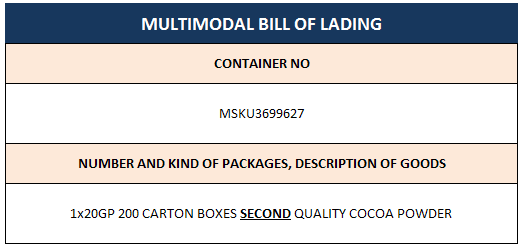
The beneficiary presented a multimodal bill of lading with the following data:

Multimodal Bill of Lading

Description of Goods: Second Quality Cocoa Powder

Discrepancy: Multimodal bill of lading shows a description of goods inconsistent with the letter of credit and other documents.

Letter of Credit Discrepancy Example: Description of Goods is Inconsistent on the Multimodal Bill of Lading

Reason for Discrepancy: Description of goods on the multimodal transport document may be shown in general terms not in conflict with that stated in the credit.

Notify Different Than Letter of Credit Discrepancy

Notify Different Than Letter of Credit Discrepancy

Notify party is the institution, to whom the shipping company informs the arrival of the cargo.

A transport document covering at least two different modes of transport is regarded as a multimodal bill of lading according to the letter of credit rules.

The notify party field on the multimodal bill of lading can be completed mainly in 2 different ways.

  1. In most cases, the notify party is the applicant or the importer on the multimodal bill of lading.
  2. In some rare occasions, the applicant and the issuing bank are both required to be stated as notify parties on the multimodal bills of lading.

The notify party field can be seen on the following transport documents : Bill of lading, multimodal bill of lading, charter party bill of lading, sea waybill, air transport document (air waybill), road transport document (CMR) and rail transport document etc.

If the issuing bank finds out that the notify party field of a multimodal bill of lading has not been completed as per letter of credit terms, then the issuing bank will issue a discrepancy, which is known as notify party different than the letter of credit.

Letter of Credit Discrepancy Example: Notify Party Different Than Letter of Credit on a Multimodal Bill of Lading

A letter of credit has been issued in SWIFT format, subject to UCP Latest Version, with the following details:

Letter of Credit Conditions

Field 50: Applicant: Al Ghazali Sons Trading Co P.O. Box No. 3268, Alkhobar 31771 Saudi Arabia. Fax: (03) 8962022 Tel: (03) 8773344

Field 46A: Documents Required: Full set of ‘clean on board’ multimodal bill of lading issued by Applicant’s Forwarder M/S. Fast Transocean Intl. Ltd., issued to the order of Banque Saudi Fransi, Alkhobar, marked ‘freight collect’ and notify applicant, evidencing shipment from any port in Spain to Dammam Port, Saudi Arabia.

The multimodal bill of lading must show the name, address and telephone number of shipping agent at the port of discharge.

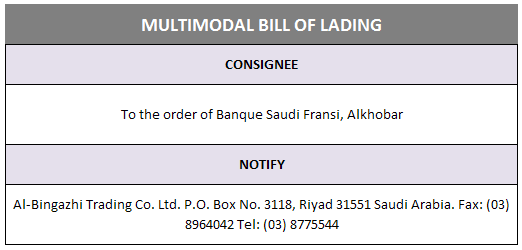
The beneficiary presented a multimodal bill of lading with the following data:

Multimodal Bill of Lading

Consignee: To the order of Banque Saudi Fransi, Alkhobar

Notify: Al-Bingazhi Trading Co. Ltd. P.O. Box No. 3118, Riyad 31551 Saudi Arabia. Fax: (03) 8964042 Tel: (03) 8775544

multimodal bill of lading notify party discrepancy

Discrepancy: Multimodal bill of lading shows a notify company which is different than what is required in the letter of credit.

Reason for Discrepancy: If a letter of credit states the details of notify parties such as company name and address, a multimodal transport document may also indicate the details of notify party.